| Dynamic Chassis Measuring System Caster |
| All Recommendations are based on a late model set up for Caraway Speedway and would apply to any asphalt track of similar length, radius, and banking. |
For our purposes, we defined caster as the fore and aft relationship between the upper
and lower ball joints. If the upper ball joint is further back (i.e. closer to the driver) than
the lower ball joint this is considered positive caster. If the upper ball joint is further to
the front than the lower ball joint, this is considered negative caster.
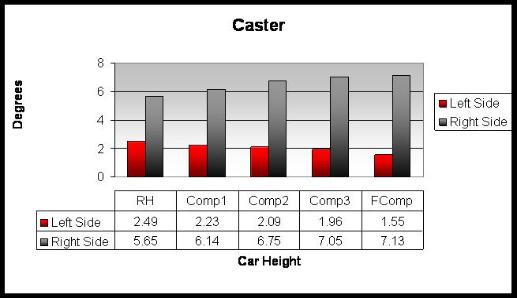
At Ride Height, we set the left side to anywhere from 1 to 2 degrees of positive caster
and the right side to anywhere from 5 to 6 degrees of positive caster.
At full compression, we like to see between 0 and 1 degree of positive caster in the left
side and 6 to 7 degrees of positive caster in the right side. We expect to see a larger
caster split at compression than we had at ride height which does help the car turn left.
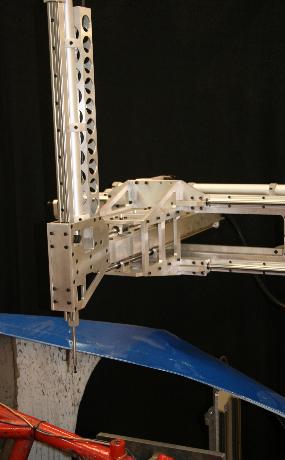
The DCMS software generates the chart below based on the information received from
the control arm touch tooling.
and lower ball joints. If the upper ball joint is further back (i.e. closer to the driver) than
the lower ball joint this is considered positive caster. If the upper ball joint is further to
the front than the lower ball joint, this is considered negative caster.
At Ride Height, we set the left side to anywhere from 1 to 2 degrees of positive caster
and the right side to anywhere from 5 to 6 degrees of positive caster.
At full compression, we like to see between 0 and 1 degree of positive caster in the left
side and 6 to 7 degrees of positive caster in the right side. We expect to see a larger
caster split at compression than we had at ride height which does help the car turn left.
The DCMS software generates the chart below based on the information received from
the control arm touch tooling.
 |
 |
 |
 |
 |
 |
 |
 |